
Most people have a vague sense that a chiropractor "cracks backs." That's roughly as accurate as saying a dentist "pulls teeth." It describes one visible action and misses almost everything else.
If you've never been to a chiropractor, or you're curious whether it's worth considering for your family, this guide explains what the job actually involves. At Thrive Chiropractic in downtown Topeka, Dr. Maggie Hunsicker and Dr. Kailee Logan treat patients from newborns to seniors, and this is the explanation we'd give you across the consultation table.
The Short Version
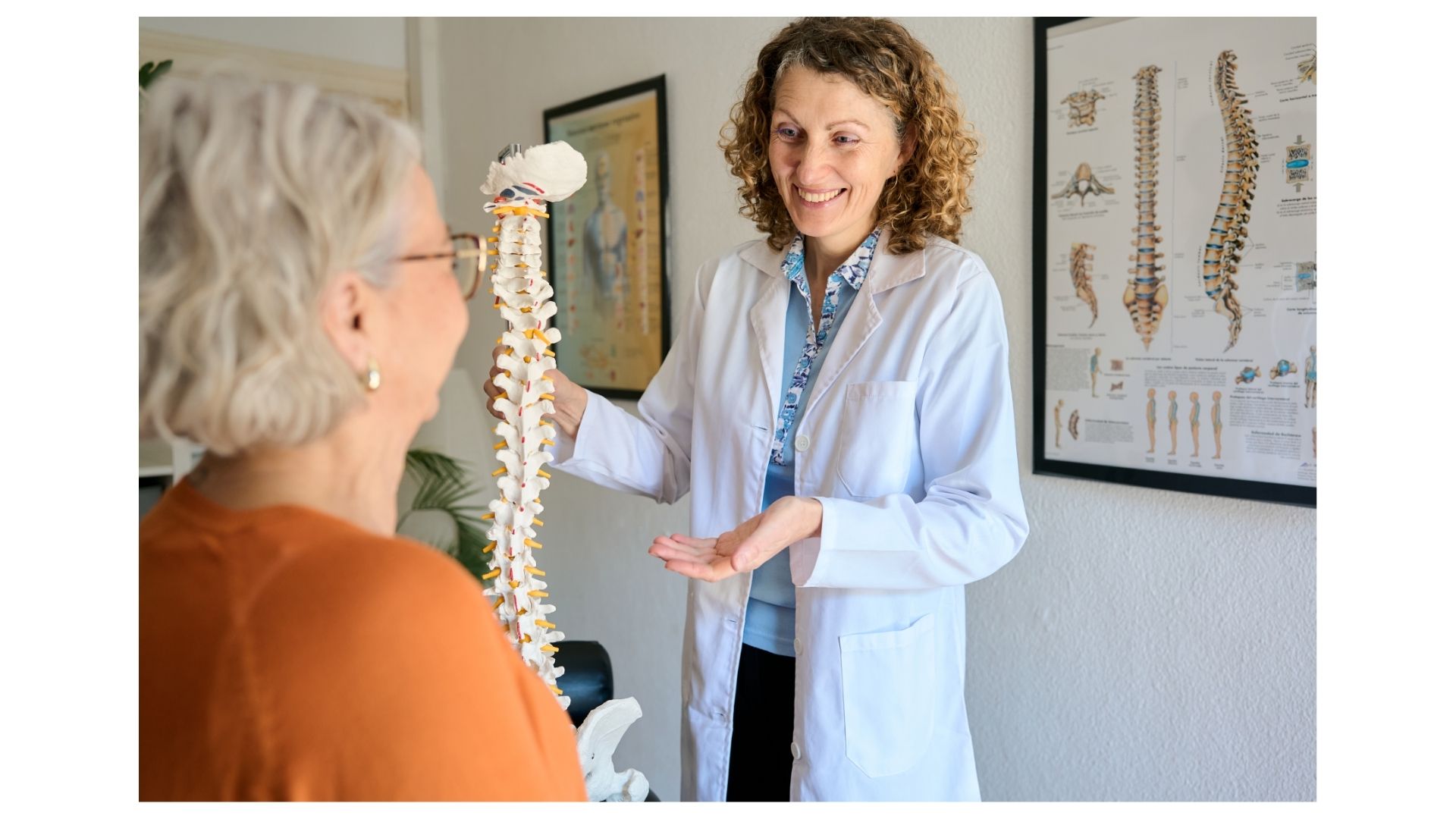
A chiropractor is a licensed healthcare provider who diagnoses and treats disorders of the musculoskeletal system, with a particular focus on the spine. The work centers on how the body's structure, especially the spine and joints, relates to how it functions.
The day-to-day job involves examining patients, identifying restricted or misaligned joints, performing hands-on adjustments to restore proper motion, and advising on posture, movement, and lifestyle factors that contribute to the problem.
What Training Does a Chiropractor Have?
This is worth knowing before you hand anyone your spine.
Chiropractors earn a Doctor of Chiropractic (DC) degree, which typically requires undergraduate study followed by a four-year doctoral program. That coursework covers anatomy, physiology, neurology, radiology, diagnosis, and extensive hands-on clinical training.
After graduation, chiropractors must pass national board examinations and obtain a state license to practice. In Kansas, licensing is overseen by the Kansas State Board of Healing Arts, and licensed practitioners must complete continuing education to maintain that license.
Dr. Maggie, for example, earned a Bachelor's degree in Exercise Physiology from Washburn University right here in Topeka before completing her Doctor of Chiropractic at Palmer College of Chiropractic, the profession's founding institution. She's also a fourth-generation chiropractor.
What Happens During a Chiropractic Visit
A proper visit is not a quick crack and a handshake. Here's the actual sequence.
1. The Consultation
Your chiropractor asks what brought you in, how long it's been going on, what makes it better or worse, your health history, prior injuries, medications, work demands, and daily habits. This conversation often reveals the cause before any hands-on work begins.
2. The Examination
This typically includes postural assessment, range of motion testing, palpation (feeling along the spine and joints to locate restriction), and orthopedic or neurological testing where relevant. Imaging is ordered only when the exam suggests it's genuinely needed.
3. The Explanation
You should hear, in plain language, what was found and what it means before anything else happens. If you leave a visit unsure what was wrong with you, something went missing.
4. The Adjustment
A controlled, targeted force applied to a restricted joint to restore normal motion. It takes under a second per joint. More on this below.
5. The Plan
Honest recommendations on frequency and expected timeline, with reassessment built in and tapering as you improve.
What Is an Adjustment, Really?
The adjustment is the signature chiropractic intervention, and the most misunderstood.
When a joint stops moving through its normal range, surrounding muscles tighten to compensate and nearby nerves can become irritated. An adjustment delivers a specific, controlled force to that joint to restore motion.
About That Popping Sound
It isn't bone cracking. It's cavitation, a rapid pressure change inside the joint capsule that releases dissolved gas. It's painless, and it isn't a measure of success. Many effective adjustments make no sound at all, particularly the gentle techniques used on infants and pregnant patients.
Not All Adjustments Are the Same
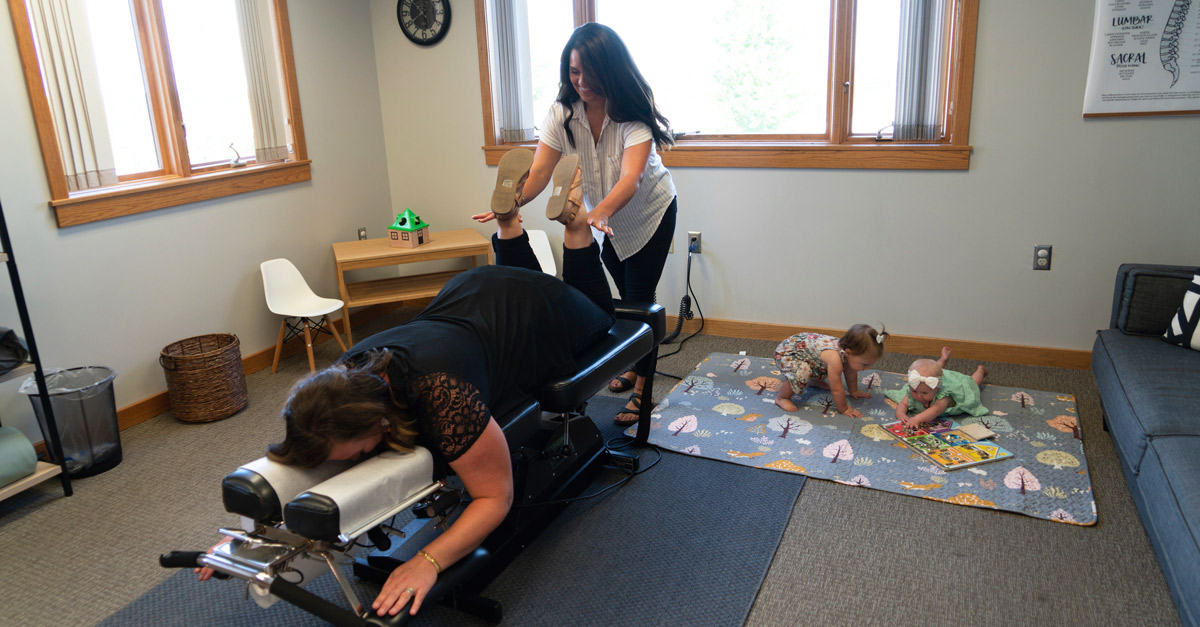
Technique is matched to the patient. Light fingertip pressure for a newborn. Pregnancy-specific methods like the Webster Technique for expecting mothers. Low-force or instrument-assisted approaches for seniors and patients with bone density concerns. Learn more on our chiropractic care page.
What Chiropractors Commonly Treat
According to the American Chiropractic Association, chiropractic is a drug-free, non-invasive approach most commonly used for:
- Lower back pain
- Neck pain and stiffness
- Tension headaches
- Joint restriction in the spine, hips, and shoulders
- Postural strain
- Sports-related musculoskeletal complaints
Research indexed through the National Library of Medicine has examined spinal manipulation for low back and neck pain, where it is among the conservative options studied. Evidence strength varies by condition, and we're candid with Topeka patients about where it's stronger and where it's thinner.
What Chiropractors Do Beyond Adjusting
The adjustment gets the attention, but a good chiropractor spends significant time on:
- Postural and ergonomic guidance. How you sit, stand, sleep, and set up your workstation often matters more than what happens in the office.
- Movement and exercise advice. Specific stretches or strengthening work to support the correction.
- Lifestyle factors. Sleep, stress, hydration, and activity all influence musculoskeletal health.
- Patient education. Helping you understand your own body so you can manage it.
- Referral when appropriate. Recognizing when a problem falls outside chiropractic scope and directing you to the right provider.
What Chiropractors Do Not Do
Clarity here prevents disappointment and builds trust.
Chiropractors do not prescribe medication or perform surgery. They do not replace your primary care physician, pediatrician, or any specialist you see. Chiropractic is not a treatment for infections, cancer, or systemic disease.
We also want to be straightforward about scope of claims. Chiropractic addresses musculoskeletal function and the nervous system's relationship to it. Claims that adjustments cure unrelated systemic illnesses are not supported by evidence, and you should be skeptical of any practitioner who makes them.
When to See a Medical Provider Instead
Seek medical attention rather than a chiropractor for severe pain following significant trauma, sudden weakness or numbness, loss of bladder or bowel control, unexplained weight loss with back pain, or fever accompanying spinal pain. A responsible chiropractor screens for these and refers out.
Do Chiropractors Treat Children and Pregnant Women?
Yes, with technique adapted accordingly.
For infants and children, pressure is extremely light, roughly what you'd use to check whether a tomato is ripe, with no twisting involved. Our pediatric chiropractic care covers what that looks like in practice.
For expecting mothers, methods are modified for pregnancy, with pregnancy pillows and thoracic drop tables for comfort. Our prenatal chiropractic care explains the Webster Technique and trimester-specific considerations.
How to Tell a Good Chiropractor From a Questionable One
Useful signals when evaluating any Topeka practice:
Good signs: examines thoroughly before adjusting, explains findings clearly, gives honest timelines, tapers care as you improve, refers out when appropriate, welcomes questions.
Worth questioning: adjusts on the first visit without an exam, requires long prepayment before you know how you respond, claims to treat conditions well outside musculoskeletal scope, or gets defensive when you ask why.
Visit Thrive Chiropractic in Topeka, KS
We're in downtown Topeka, convenient to College Hill, Westboro, Potwin, Oakland, and communities across Shawnee County.
Thrive Chiropractic
509 SW Jackson St, Topeka, KS 66603
Phone: (785) 331-4515
Office Hours:
Monday: 9 AM to 5 PM
Tuesday: 9 AM to 2 PM
Wednesday: 9 AM to 5 PM
Thursday: 9 AM to 5 PM
Friday through Sunday: Closed
Still Have Questions? Come Ask Them in Topeka
If you're curious whether chiropractic makes sense for you or your family, a consultation costs you nothing but time. We'll examine, explain what we find, and tell you honestly whether we can help.
Take advantage of our New Patient Special or reach out through our contact page to schedule.
Call or text us today at (785) 331-4515.
Frequently Asked Questions
What does a chiropractor do, in simple terms?
A chiropractor examines and treats problems with the spine, joints, and muscles, mainly through hands-on adjustments that restore normal joint motion, alongside guidance on posture, movement, and lifestyle.
Do I need a chiropractor or should I see my doctor first?
See your physician first for anything involving trauma, fever, unexplained weight loss, or sudden neurological symptoms. For ordinary back stiffness, neck tension, or postural strain, a chiropractor is a reasonable starting point. If we find something outside our scope, we'll refer you.
Is a chiropractor a real doctor?
Chiropractors hold a Doctor of Chiropractic degree and are licensed healthcare providers, but they are not medical doctors. They don't prescribe medication or perform surgery.
Do I need a referral to see a chiropractor in Topeka?
No. You can book directly by calling (785) 331-4515 or using our contact page.
Does an adjustment hurt?
Usually not. Most people describe quick pressure followed by a sense of release. Mild soreness the next day is common. Sharp pain during an adjustment is not normal and should be mentioned right away.
How many visits will I need?
It depends on what's going on and how long it's been there. Recent, simple restrictions may resolve quickly. Long-standing patterns take longer. We give honest timelines after the exam rather than generic packages.
Can chiropractic help conditions unrelated to my back?
Chiropractic addresses musculoskeletal function and nervous system relationships. Be cautious with any practitioner claiming to cure unrelated systemic diseases, as those claims aren't supported by evidence.
Medical Disclaimer: This article is for informational purposes only and is not a substitute for personalized medical advice. Seek prompt medical attention for severe pain after trauma, sudden weakness or numbness, loss of bladder or bowel control, fever with back pain, or unexplained weight loss.
About the Authors: Dr. Maggie Hunsicker, DC, is a fourth-generation chiropractor and graduate of Palmer College of Chiropractic. Dr. Kailee Logan, DC, is dedicated to family-centered care. Together, they lead Thrive Chiropractic in Topeka, KS.